Publishing in an era of Digital Fragmentation
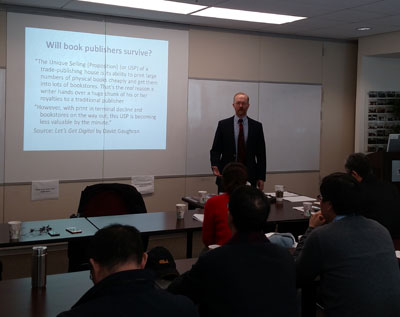 |
I recently gave a talk to some Chinese businessmen on digital publishing. The slideshow (with some notes) is available here.
The main theme of the talk is that the digital revolution is not consolidating things onto digital — as if everything is moving to the iPad. Rather, it’s fragmenting things — creating more and more places where content can be served and consumed.
There are more and more reader devices using their own specs (epub, mobi, KF8, etc.). Then there are apps for those services on other devices (iPads, android tablets, smart phones). Then there’s the web, which can be different on desktop, tablet and mobile.
There is no perfect solution, but there are some practical things publishers can do to mitigate the harm.
“Digital” is not replacing print. It’s simply adding more options. That’s why I call it “digital fragmentation.”
What is a magazine?
Toward the end of my Dec. 1 edition I ask what is a digital magazine. D.B. Hebbard weighs in from a different perspective in this article: What is a magazine?
Mr. Hebbard is answering people who say that there’s no need for a Netflix for magazines because it already exists, and it’s called the internet. Hebbard correctly responds that a magazine is a different thing from a website. He says the mistake is a matter of “equating brands with products.”
The Atlantic’s 10-time a year print product is a magazine, its website is – need I say it – a website. They are not the same thing, even though they share content and a brand name. The reading habits of its loyal customers are different, as is the product.
He’s right. They are very definitely not the same thing.
For me, a magazine is a collection of stories (articles, essays, etc.) put together by an editor for the reader in one publishing package. It is complete unto itself. While it can have additional material through references to past issues, links and the like, it is meant to be read as a whole – either at one time, or over an extended period.
In this way, it is NOT like a website, which can have the same content, and be edited by the same editor, but has no beginning, middle or end when it comes to its total content. Stories stay on websites indefinitely, and article appearing in January is housed on the same site as the story that first appeared in December.
I don’t think the reader particularly cares that there’s an editor (that sounds a bit like the mindset of someone who looks at things from the publisher’s perspective), but I mostly agree with the rest, and he makes some other points in the article that are well worth your attention.
An issue of a magazine often (but not always) has a focus that ties the articles together. But there are other things that distinguish a magazine that people forget about, like …
- You can put it on your coffee table
- You’re likely to find one at the barber shop
- It has a cover that is designed to attract your attention
- You might want to share it with a friend.
I’m not trying to be silly. These are not inconsequential elements of what we expect from the word “magazine,” and they help to highlight why (1) website, (2) digital issue and (3) print magazine are really three very different things.
It has been a meme for many years now that print publishers don’t get digital publishing (and the web, in particular) because print is all they know. But I see many digital publishing people today who don’t seem to get the magazine.
I don’t think it’s a matter of “getting” something so much as it’s a confused question. “Digital magazine” is a term that breeds confusion. It’s like calling a motorcycle a two-wheeled car, and then telling the Harley guy that he doesn’t “get” cars.
We need a new word for digital editions of magazines. Webazines or Tabazines or …. Okay, those are awful, but continuing to call them “digital magazines” is only going to reinforce the confusion.
We not only have the best quality mlb, nhl, ncaa,
nba jerseys, but also cheap youth soccer jerseys, come and have a look.